Qatar Company Not Giving NOC? Follow These 5 Steps

In 2020, Qatar officially abolished the No Objection Certificate (NOC) requirement for changing employers. However, many workers still encounter resistance, system delays, or intimidation from current sponsors.
If your company is blocking your transfer, the law is on your side, provided you follow the correct administrative path. Here is the professional guide on how to force a transfer through the Ministry of Labour (MOL).
1. How Qatar Labour Law Protects Your Right to Transfer

Under the current Qatar Labour Law, an employee may change jobs at any time during their contract. You no longer need a physical or digital “OK” from your current boss to switch.
The two mandatory requirements are:
- Written Notice: You must serve your notice period (1 month if employed for less than 2 years; 2 months if more than 2 years).
- Electronic Notification: The transfer must be processed through the Ministry of Labour’s (ADLSA) online portal.
2. Step-by-Step Recovery Process (When Companies Say No)
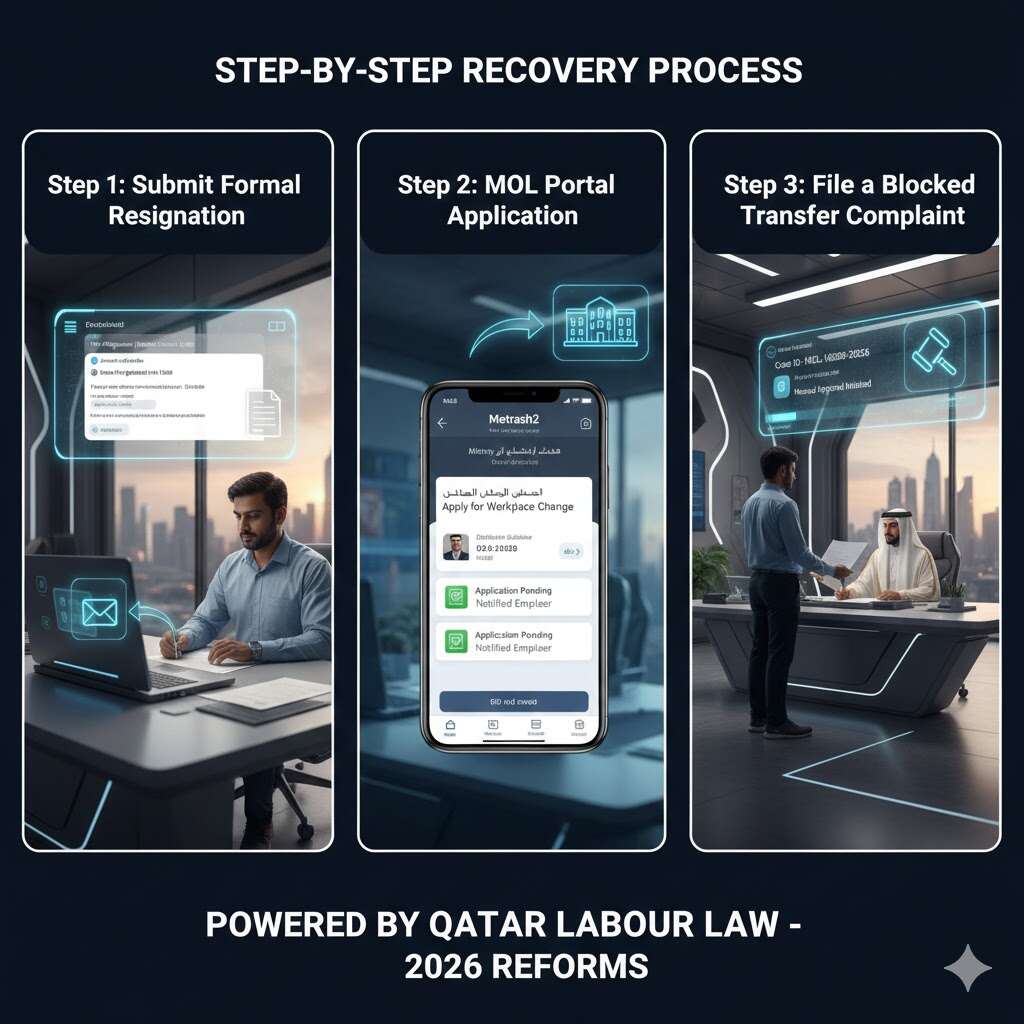
If your employer refuses to cooperate or ignores the system notifications, follow these steps to secure your transfer manually.
Step 1: Secure Your Evidence
Before confronting HR, ensure you have documented proof. Send your resignation via email and keep the “Sent” receipt. If they refuse to sign a hard copy, a recorded email is legally sufficient proof of notice in Qatar courts.
Step 2: Initiate the Transfer via Metrash2/MOL Portal
Your new employer must initiate the transfer. Once the request is in the system, your current employer receives an SMS.
- The Trap: If the employer does not respond within 7 to 10 days, the request often expires.
- The Solution: Do not wait for a second expiry. Once the first request is ignored or rejected without a valid legal reason, proceed to Step 3.
Step 3: File a “Blocked Transfer” Complaint
Visit the Labour Relations Department (locations in Al Khor, Industrial Area, or Al Shahaniya). Bring:
- Your QID.
- The original offer letter from the new company.
- Proof of resignation (the email you sent).
- Evidence that the current company is intentionally delaying the process.
Result: A Labour Officer has the authority to override the employer’s silence. They can manually approve the transfer if the employer cannot prove a legal violation (such as an active criminal case against you).
3. Dealing with Employer Intimidation
Employers often use specific threats to prevent workers from leaving. Here is how to handle them legally:
| Common Threat | Legal Reality in Qatar | Action Required |
| “We will cancel your QID” | It is illegal to cancel a QID while a transfer is pending in the system. | Report “Malicious Cancellation” to the Ministry of Labour immediately. |
| “We will file a Huroob (Absconding)” | If you are reporting to work during your notice period, a Huroob charge is fraudulent. | Keep attendance logs or time-stamped photos of yourself at the workplace as evidence. |
| “You must pay for your visa costs” | Article 33 of the Labour Law prohibits employers from charging workers for recruitment or visa costs. | Do not pay. Report the demand for money to the CID or Labour Department. |
4. Key Resources & Hotlines (2026 Update)
If you are stuck, use these official channels to escalate your case:
- Ministry of Labour Hotline: Dial 16008 or 16505.
- The “Amerni” App: Download the app and use the “Labour Complaint” feature to file a dispute digitally.
- WhatsApp Support: Contact the Ministry’s automated service at +974 92727 to check your application status.
- Labour Dispute Committee: Located in Lusail, this is where cases regarding unpaid End of Service Benefits (Gratuity) and blocked transfers are settled by a judge.
5. Summary Checklist for Success
- Do not stop working: Ensure you complete your notice period. Leaving early gives the employer a legal reason to block your transfer.
- Get a PRO (Mandoub): If your new company has an experienced PRO, they can often settle the “No NOC” issue by visiting the Ministry in person.
- End of Service Benefits: Your current employer is legally required to pay your gratuity, even if you are the one resigning. These funds cannot be withheld as a “penalty” for leaving.